
The short answer
If fragrance is 8% of wax weight, divide your finished blend weight by 1.08 to find wax. If fragrance is 8% of the finished blend, multiply the finished blend weight by 0.08 to find fragrance. Neither convention tells you whether that load is suitable for your wax or candle design.
One 200 g candle, two recipes
| Convention | Wax | Fragrance |
|---|---|---|
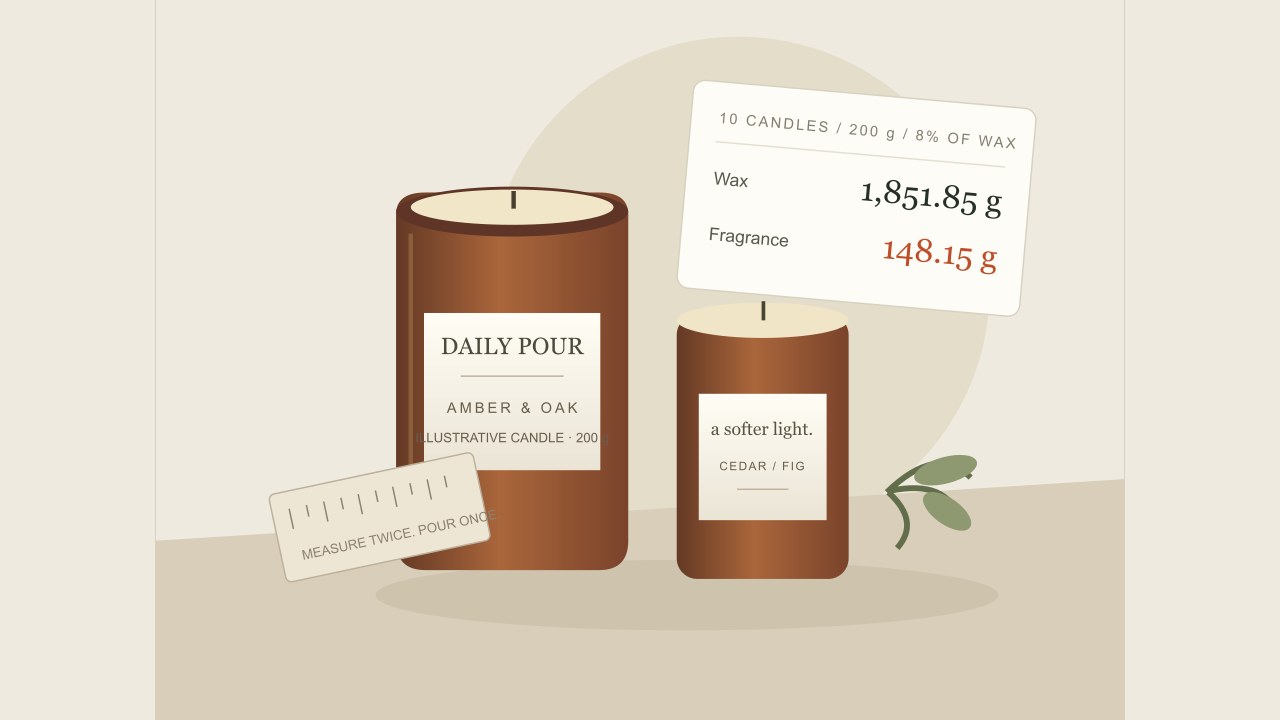
| 8% of wax | 185.185185 g | 14.814815 g |
| 8% of finished blend | 184 g | 16 g |
Both total 200 g, but the fragrance quantity differs by about 1.19 g per candle. Across 100 candles, that difference is about 118.52 g. This is why copying a percentage without its convention can change a production batch.
How much fragrance oil for 1 kg of wax?
When 1 kg means wax alone and fragrance is 8% of wax weight, fragrance is 1,000 × 0.08 = 80 g. The finished blend is 1,080 g. At 6% it is 60 g; at 10% it is 100 g. These are arithmetic examples, not safe-load recommendations.
If 1 kg means the finished wax-and-fragrance blend instead, 8% of wax requires 925.93 g wax and 74.07 g fragrance. If the recipe uses 8% of finished blend, use 920 g wax and 80 g fragrance. Specify both the starting weight and percentage basis.
For a fragrance load calculator, use our wax and fragrance batch tool. It starts from finished fill weight rather than wax-only stock weight.
Translate the convention, not just the number
A load r expressed as a fraction of wax becomes r ÷ (1 + r) as a fraction of finished blend. Thus 8% of wax is approximately 7.4074% of blend. In the other direction, blend fraction b becomes b ÷ (1 − b) of wax, so 8% of blend is approximately 8.6957% of wax.
These are mathematical conversions, not recommendations to increase fragrance. Confirm what convention your supplier and tested recipe actually use.
Allowance does not change the recipe ratio
Ten 200 g candles require 2,000 g finished blend before losses. A 10% allowance makes the planning total 2,200 g. Split that total using the same selected fragrance convention; do not add allowance a second time to each ingredient.
Calculate your batch →Before a production pour
Measure fill by weight without the vessel and wick. Weight ounces are different from fluid ounces. Use your manufacturer’s permitted load and suitable candle tests; neither a jar size nor a calculator chooses a safe recipe.
Reference: CandleScience batch calculator. Our methodology documents the formulas used here.